Coming Soon
AI & Deep Learning
Machine Learning Fundamentals — From Workflow to Trustworthy Models
A full practical ML track covering scikit-learn, baselines, evaluation, supervised and unsupervised models, pipelines, hyperparameter tuning, and interpretability.
This course / diploma is coming soon
This course is coming soon — register your details and we'll notify you when it launches.
Pricing on launch
Available as part of AI diploma bundles
الكورس ده قيد التحضير — سجل بياناتك وهنبلغك أول ما ينزل.
🚀 Enrollment opens soon
🔔 Sign up to be notified
🎯 Why this diploma is worth it
Not a watch-and-forget course — a complete technical reference that lives with you
You get the videos, materials, quizzes, exams and projects — a solid, always-updated reference for every technology in the diploma. You won't need another source.
Lifetime reference + yearly updates
Come back anytime — at work, in interviews, in projects. Refreshed every year so it stays up to date.
Everything in one place
Deep-dive videos + materials + quizzes + exams for every part — a complete curriculum, not just lectures.
Learn at your own pace
Fully recorded. Finish on your schedule, complete a part each month, and progress step by step.
Real projects on GitHub
0+ hands-on projects you submit and push to a GitHub repo — building a portfolio that convinces any employer.
Manual review + industry instructors
Your projects are reviewed by hand, taught by instructors working in the industry — real feedback that levels you up.
Verified certificate + training letter
A QR-verifiable certificate + an Arabic/English training letter that convinces HR — ready for jobs and college.
3Learning outcomes
0Tools & tech
0Hands-on projects
★ 4.9Avg student rating
What you will learn
- ✅ Ship end-to-end classical ML projects
- ✅ Choose and evaluate models correctly
- ✅ Debug bias/variance, leakage, and interpretability issues
Curriculum & units
📚 13 units
🪜 25 steps
⏱️ Flexible
Introduction 1 topics · Flexible pace
- Lesson 1: AI vs ML vs DL + ML Workflow — Definitions, where classical ML fits, typical ML pipeline; baseline-first mindset; mini-workshop: map 5 problems to ML type + outline pipeline
Unit 1: Practical ML Setup 2 topics · Flexible pace
- Lesson 1: scikit-learn + Problem Types — Estimator API (fit/predict/score), datasets, regression vs classification vs clustering; labels/features/targets; hands-on: train first model end-to-end
- Lesson 2: Baselines + Reproducibility — Dummy baselines + heuristics; sanity checks; random_state; repeatable splits; comparing runs fairly; mini-lab: beat baseline and explain variance
Unit 2: Evaluation Fundamentals 5 topics · Flexible pace
- Lesson 1: Splits + CV + Leakage — Quick recap: train/val/test, stratification, time split concept; K-fold/Stratified K-fold; leakage patterns; mini-lab: choose split strategy + fix leakage
- Lesson 2: Regression Metrics + Residuals — RMSE/MAE/R2; compute on small example; outlier sensitivity; residual plots; business metric selection; mini-lab: evaluate 2 models + interpret residuals
- Lesson 3: Classification Metrics + Thresholds
- Lesson 4: ROC/PR + Calibration — ROC-AUC vs PR-AUC (imbalanced focus); baseline PR; curve interpretation; calibration intuition; mini-lab: compare ROC/PR + calibrated vs uncalibrated outputs
- Lesson 5: Learning Curves + Bias/Variance Plan
Unit 3: Regression Models 3 topics · Flexible pace
- Lesson 1: Linear Regression Deep Dive — Intuition + geometry; assumptions; coefficient interpretation; multicollinearity intuition; mini-lab: train + interpret coefficients responsibly
- Lesson 2: Polynomial + Regularization — Polynomial features; overfitting diagnosis; Ridge/Lasso/ElasticNet (shrinkage vs sparsity); scaling reminders; mini-lab: compare Ridge/Lasso/EN and justify choice
- Lesson 3: Regression Debugging Workshop — Outliers + leverage points; heteroscedasticity symptoms; residual patterns; quick mitigation strategies; mini-lab: diagnose broken regression and improve
Unit 4: Classification Models 2 topics · Flexible pace
- Lesson 1: Logistic Regression + Multiclass — Decision boundaries; probabilities; log loss intuition (no heavy math); One-vs-Rest vs Multinomial; mini-lab: multiclass evaluation + confusion analysis
- Lesson 2: Classification Error Analysis — Slice analysis; false positive/negative review; threshold recap; mini-lab: find weakest subgroup + propose fixes
Unit 5: Distance & Probabilistic ML 2 topics · Flexible pace
- Lesson 1: kNN End-to-End — Distance intuition; scaling requirement; choosing k; distance metrics; curse of dimensionality; failure modes; mini-lab: tune kNN + measure latency
- Lesson 2: Naive Bayes (Variants + Smoothing)
Unit 6: Support Vector Machines 1 topics · Flexible pace
- Lesson 1: SVM + Kernels + Tuning — Margin/support vectors; RBF/poly kernels intuition; scaling + compute warnings; C/gamma tuning; mini-lab: visualize kernel boundary + tune SVM
Unit 7: Trees & Bagging 2 topics · Flexible pace
- Lesson 1: Decision Trees (Core → Pitfalls) — Splits/impurity; interpretability; pruning/overfitting; high-cardinality pitfalls; mini-lab: build tree, prune, and re-evaluate
- Lesson 2: Bagging + Random Forests — Bootstrap averaging; feature subsampling; tuning knobs; feature importance caveats; mini-lab: tune RF + analyze errors
Unit 8: Boosting & Ensembles 2 topics · Flexible pace
- Lesson 1: Boosting + Gradient Boosting — Boosting intuition; learning_rate/estimators/depth; early stopping concept; mini-lab: tune GBDT and justify choices
- Lesson 2: Voting + Stacking + Model Choice — Voting vs stacking; leakage risks; safe stacking pattern; model selection cheat sheet; workshop: pick models for 5 tabular scenarios
Unit 9: Pipelines & Tuning 2 topics · Flexible pace
- Lesson 1: Pipelines + Safe Feature Selection
- Lesson 2: Hyperparameter Search — Grid vs random search; budget thinking; GridSearchCV scoring/refit/cv; nested CV concept; mini-lab: correct vs incorrect tuning comparison
Unit 10: Unsupervised ML 2 topics · Flexible pace
- Lesson 1: Clustering (Overview + k-Means) — When clustering is meaningful; similarity choice; k-means init; choosing k; inertia vs silhouette; mini-lab: elbow vs silhouette comparison
- Lesson 2: Hierarchical + DBSCAN + Evaluation
Unit 11: Dimensionality Reduction 2 topics · Flexible pace
- Lesson 1: PCA + TruncatedSVD — Variance directions; scaling reminder; PCA for visualization; TruncatedSVD for sparse data; mini-lab: explained variance + component interpretation
- Lesson 2: t-SNE/UMAP + Pitfalls — Visualization purpose; parameter sensitivity; why not for modeling claims; pitfalls (leakage/over-interpretation); mini-lab: run and compare settings
Unit 12: Practical ML Problems 1 topics · Flexible pace
- Lesson 1: Imbalanced + Missing + Outliers
Unit 13: Interpretability & Trust 2 topics · Flexible pace
- Lesson 1: Feature Importance + SHAP idea — Permutation vs built-in importance; stability; SHAP intuition; communicating responsibly; mini-lab: compare importance methods + explain 3 cases
- Lesson 2: Bias & Fairness Basics — Bias sources; subgroup evaluation; reporting responsibly; mini-lab: evaluate subgroup slice and discuss tradeoffs
Project 1 topics · Flexible pace
- End-to-End ML Project — Framing → EDA (Course 2) → baseline → compare models → tuning → interpretation → final report + error analysis
Projects you will build
Tools & platforms
Target audience
- Aspiring ML engineers
- Data analysts moving deeper into modeling
- Engineers building their first serious ML portfolio
Career paths
What you receive after finishing
Verification-ready certificates and HR-friendly training letters.
Verified Certificate
Official Learn in Depth completion certificate with QR verification.
Verifiable on the public verification page.
English Training Letter
For international companies and overseas employment.
On official Learn in Depth letterhead, signed by the instructor.
Arabic Training Letter
For local employers in MENA and university coordination.
Bilingual stamped letter ready for HR submission.
Company-Stamped Certificate
Company-stamped, for academic credit. Request it by contacting +20 155 876 5064 via WhatsApp or phone.
Issued upon request after successful completion.
Course FAQ
When will these diplomas launch? إمتى الدبلومات دي هتفتح؟
The current target is Q3 2026. Register via the form and we will send launch and pricing updates first.
المستهدف الحالي هو Q3 2026. سجّل بياناتك في الفورم وسنرسل لك أول تحديثات الإطلاق والأسعار.
Can I register right now? هل أقدر أحجز دلوقتي؟
These tracks are currently marked Coming Soon. You can browse the curriculum and leave your details to be notified when registration opens.
حاليًا المسارات في حالة Coming Soon. تقدر تتصفح المحتوى وتسجل اهتمامك لنبلغك عند فتح التسجيل.
Will there be a verified certificate? هل في شهادة موثقة؟
Yes — every track is designed around a verified certificate and hands-on project review.
أيوة — كل مسار مصمم بشهادة موثقة ومراجعة عملية للمشاريع الرئيسية.
Is the content tailored for engineers in Egypt and the Arab region? هل المحتوى مناسب للمهندسين في مصر والمنطقة العربية؟
Yes. The positioning, support, and project design target engineers in the Egyptian and Gulf markets with a strong practical hiring focus.
أيوة، التسويق والدعم وبناء المشاريع معمولين خصيصًا لمهندسين السوق المصري والخليجي مع تركيز على التوظيف العملي.
How do I reset my device if I changed my phone or computer? لو غيّرت الجهاز (موبايل أو كمبيوتر)، إزاي أعمل reset؟
Send a WhatsApp message to +201558765064 saying: "I need to reset my device ID" along with your email. We'll reset the old device and you can immediately access on the new one.
ابعت رسالة على واتساب +201558765064 وقول: "عايز أعمل reset لل ID بتاعي" واكتب الإيميل بتاعك. هنعمل Reset للجهاز القديم وتقدر تفتح على الجهاز الجديد فوراً.
How do I register? إزاي أسجل في الكورس؟
Create your account, add the course to cart, and follow the payment steps.
سجل حسابك وأضف الكورس للسلة واتبع خطوات الدفع.
Is there a student discount? هل في خصم للطلبة؟
Yes — students get an automatic discount shown at checkout.
أيوه — الطلبة ليهم خصم خاص بيظهر أوتوماتيك.
Are courses recorded or live? هل الكورسات مسجلة ولا لايف؟
All courses are recorded so you can learn at your own pace.
كل الكورسات مسجلة عشان تتعلم في أي وقت يناسبك.
Are courses free for Palestine? هل فلسطين الكورسات مجانية؟
Yes — all courses are free for people from Palestine.
أيوه — كل الكورسات مجانية لأهل فلسطين.
What payment methods are available? إيه طرق الدفع المتاحة؟
Bank transfer, Vodafone Cash, InstaPay.
تحويل بنكي، فودافون كاش، إنستاباي.
Related courses
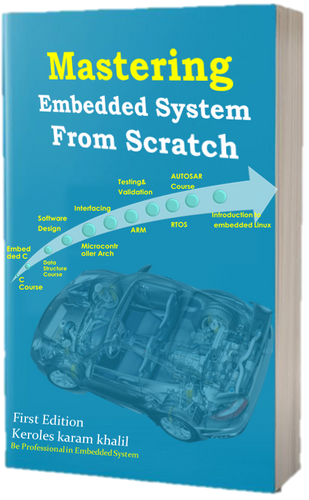
Embedded Systems
Embedded System In-Depth Diploma
From MCU foundations to Bare-Metal & RTOS mastery
1,500 EGP
3,000 EGP
50% Student Discount
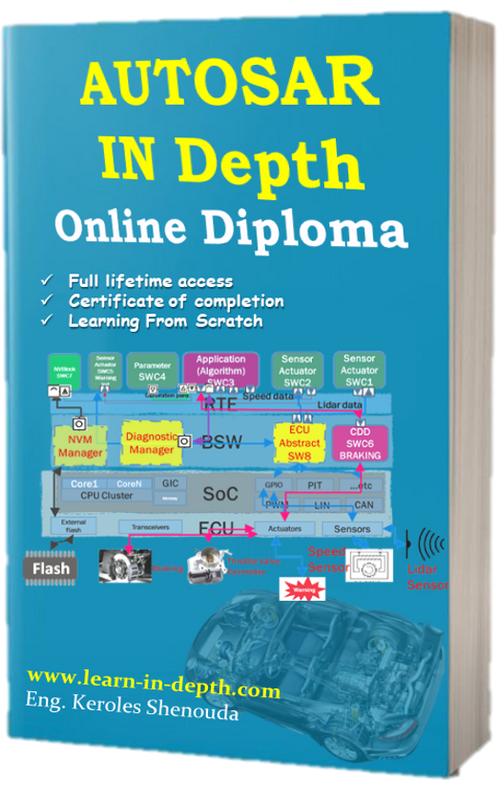
Automotive / AUTOSAR
AUTOSAR In-Depth Diploma
AUTOSAR Classic Platform — Configuration, BSW, RTE
2,400 EGP
4,800 EGP
50% Student Discount
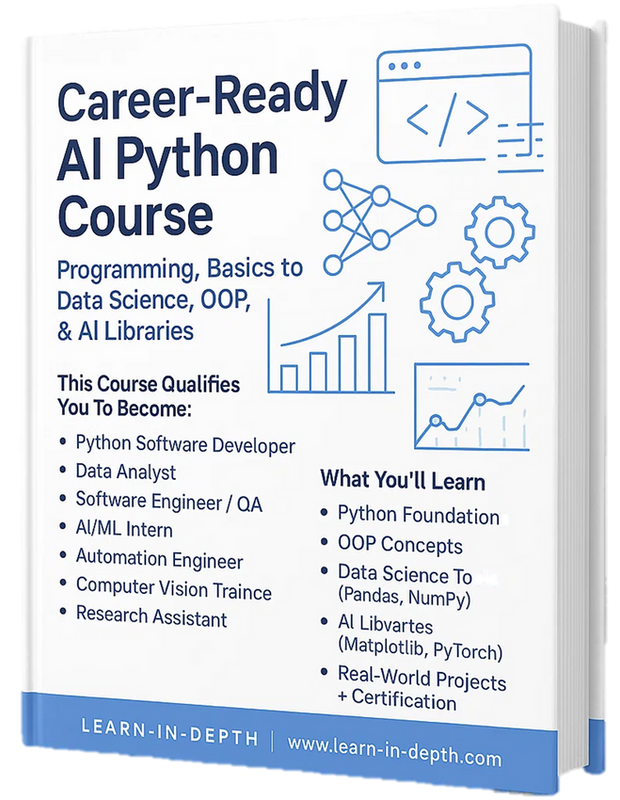
Programming
Master Python — Deep Learning & DevOps
Python for Deep Learning and DevOps in one track
750 EGP
1,500 EGP
50% Student Discount
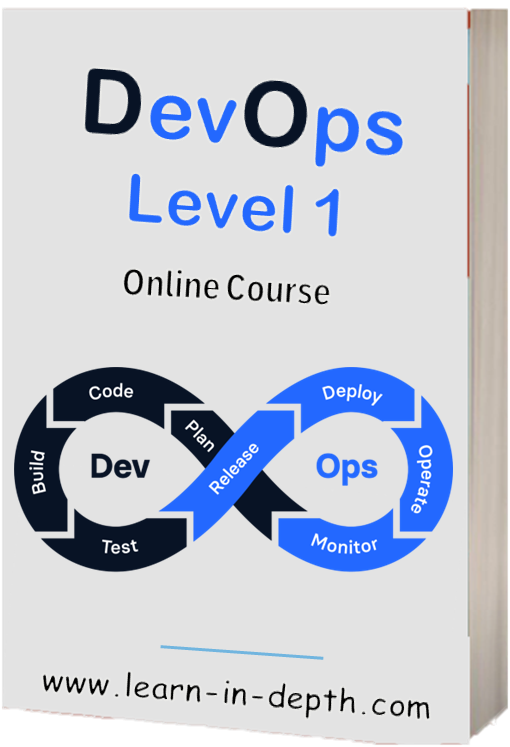
DevOps
DevOps Level 1 Diploma
Linux, Git, CI/CD, Docker — the solid DevOps foundation
2,000 EGP
4,000 EGP
50% Student Discount